Essay · · 9 min read
Prediction: Simulated Time Travel Is Coming
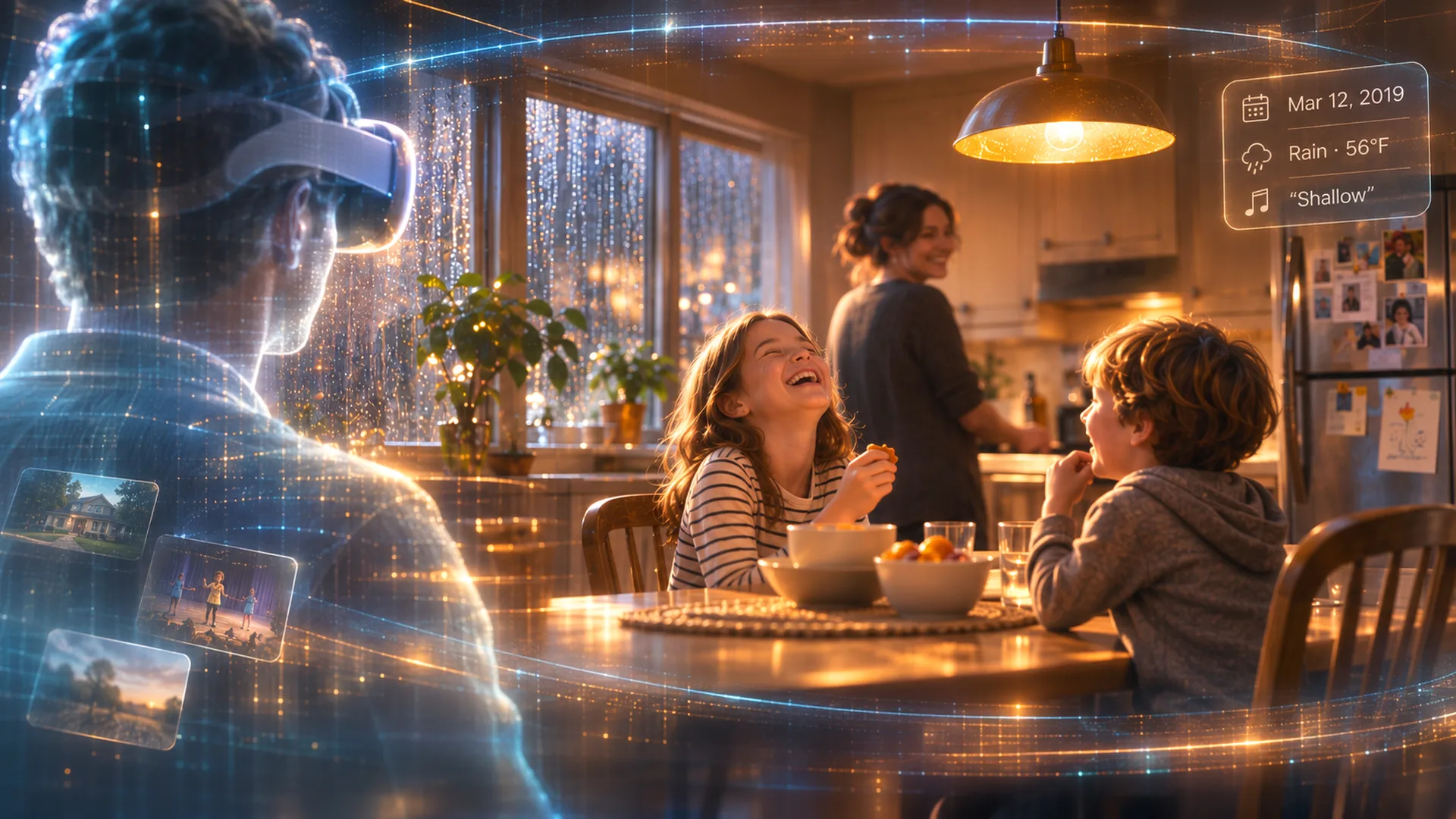
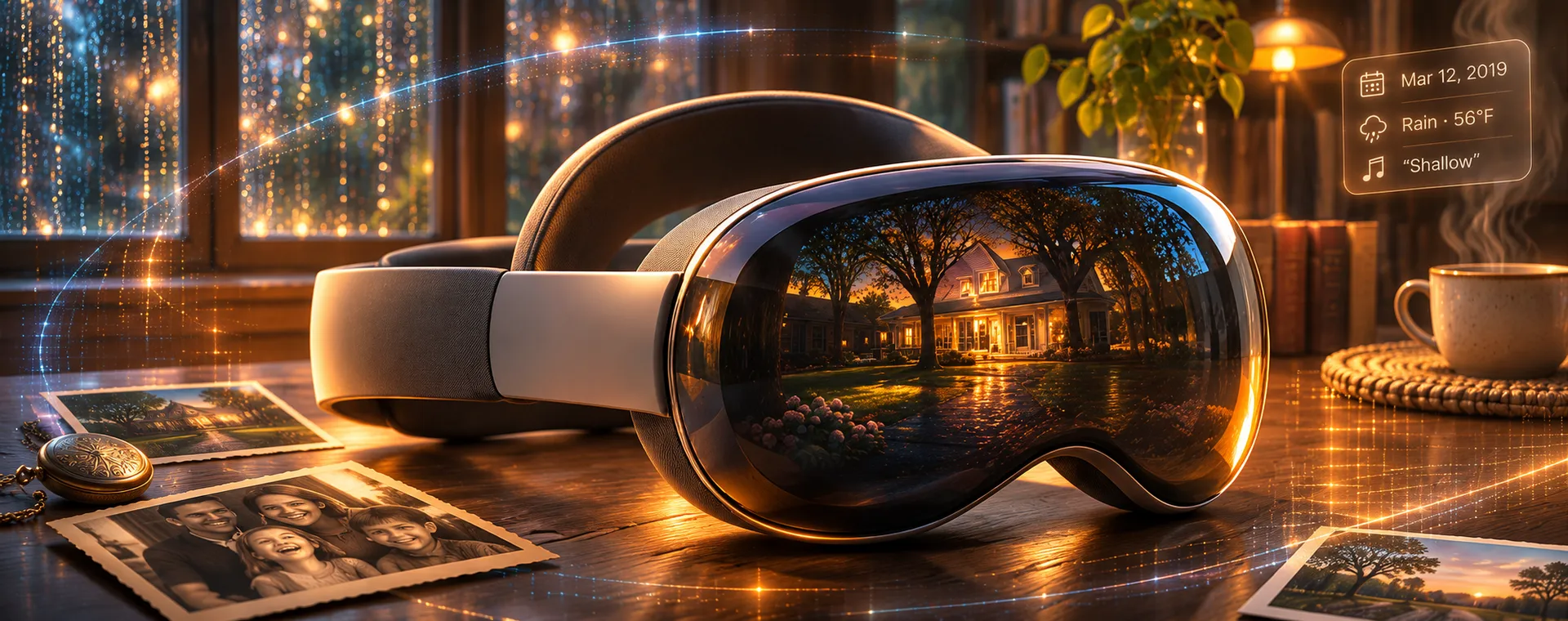
Take me back to March 12, 2019.
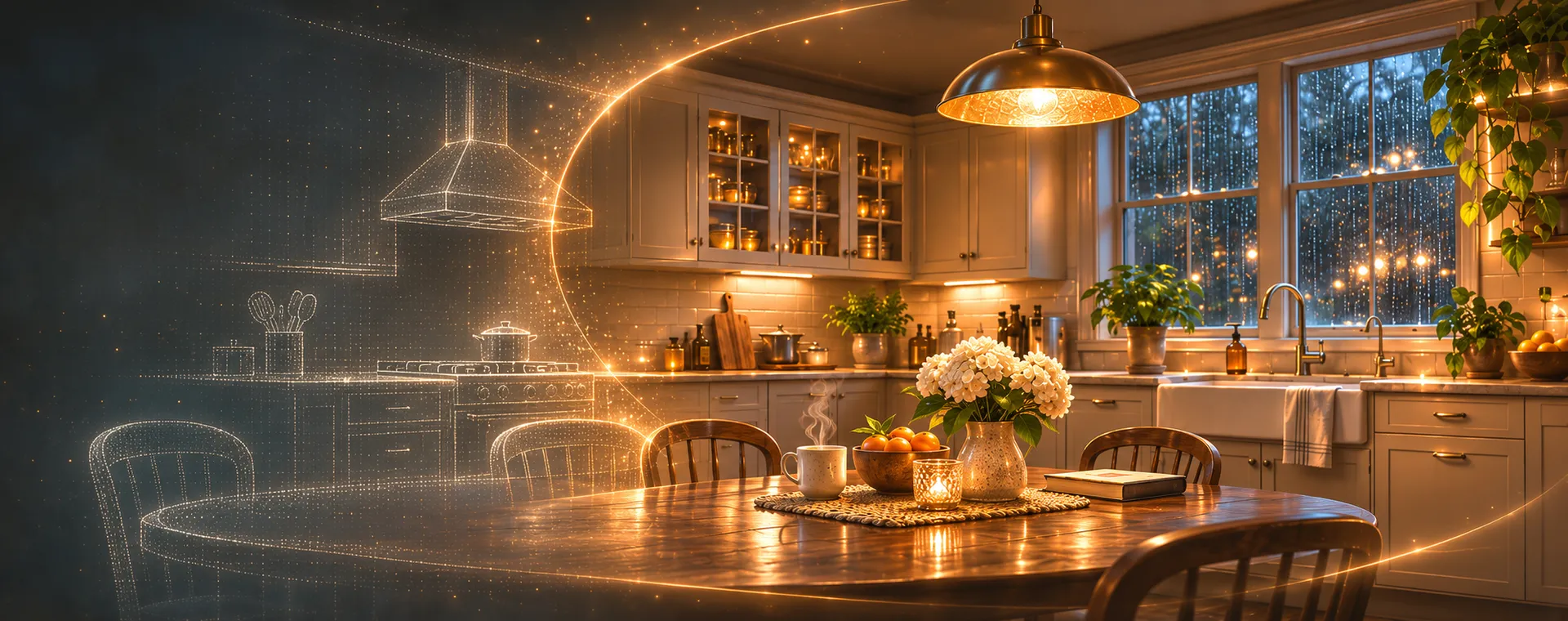
Say that to a device a few years from now and I think something incredible happens. Not a slideshow with piano music under it. You put on a headset and you’re standing in the kitchen of the house you lived in then, the one with the bad light fixture you kept meaning to replace. It’s raining outside, because it actually was. Your kids are the height they actually were. Something’s playing that everybody was playing that spring. You can turn around and look at the room behind you.
I’ve thought about this for years, and the pieces have gotten close enough that I want to put the idea down while it still sounds strange. Call it simulated time travel: a reconstructed, walkable version of a specific day in your own life, assembled from data that already exists.
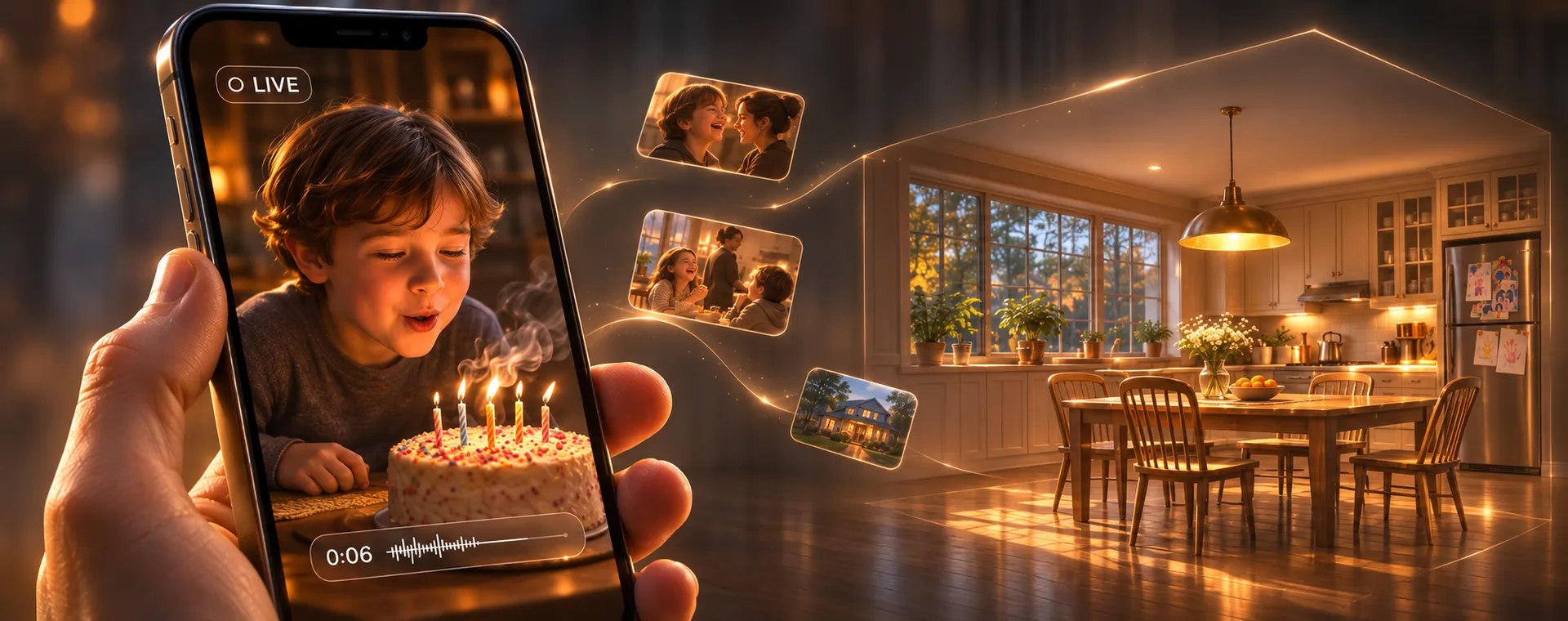
The starting point is sitting in your camera roll. Since 2015, every Live Photo your iPhone has taken recorded about three seconds of video and audio wrapped around the shutter click. You’re carrying thousands of tiny movies with sound, shot inside your actual house, from angles you chose without thinking about it. Meanwhile, 3D Gaussian splatting got good and fast around 2023, and it rebuilds a walkable 3D space out of exactly that kind of ordinary photo set.
The days you’d go back to
Your daughter’s winter concert, the one you watched through a phone screen the entire time because you were filming it. Go back and stand in the third row with your hands empty. Look at the other parents. Look at the kid two seats down who’s asleep. You get the four minutes you traded away for the recording.

The game where your son finally got in. You were on the far sideline and you missed the play because you were talking to somebody’s dad. Go stand behind the bench this time.
A concert from your twenties. You know exactly which one.
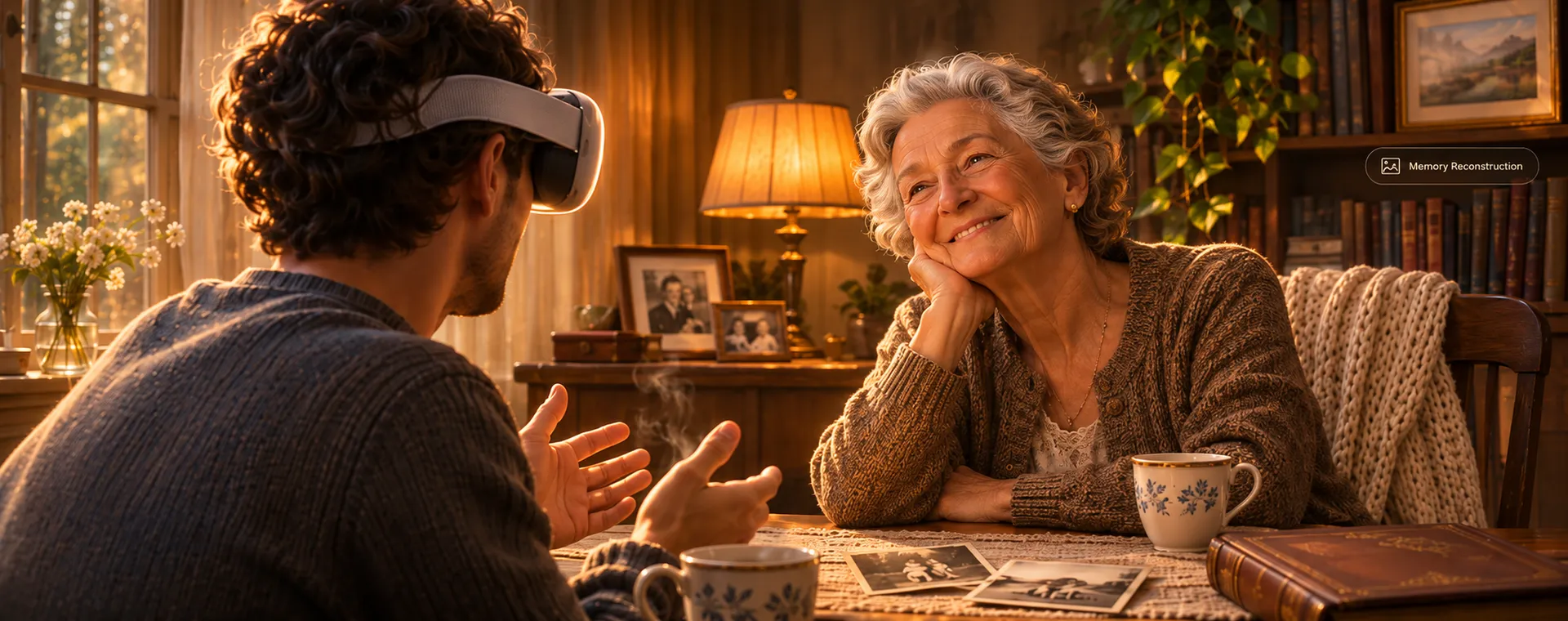
And the one that’s going to make everybody uncomfortable, including me: a conversation with someone you lost. Sitting across from a version of your grandmother in the room she actually lived in, hearing the way she actually said your name. Yes, I’m aware I’m describing a Black Mirror episode. Two of them, actually: “The Entire History of You” had people replaying their own memories back in 2011, and “Be Right Back” rebuilt a dead boyfriend out of his old messages in 2013. I’d like us to skip the third act. It’s also, I’m fairly sure, where this ends up, because it’s the thing people will want most and the technology doesn’t care whether we’re ready.
Not one of these needs a new sensor, a new device, or a single additional thing collected about you. They need somebody to assemble what’s already sitting there.
The rest of the raw material is sitting in your account right now
Photos carry more than the images. Each one is stamped with GPS coordinates and a timestamp down to the second, so a library of tens of thousands doubles as a movement log nobody meant to keep. Your living room in 2019 is recoverable because you shot a birthday party in it from six different angles.
Then the rest of it:
- Location. Google Maps Timeline keeps a day-by-day record of where you went, now stored on your phone instead of Google’s servers. Apple’s Significant Locations does its own version. Between those and the GPS baked into your photos, “where was I on a Saturday in 2019” is already answered.
- Calendar. Whether you were traveling, at a wedding, in a conference room, or home with nothing on the books.
- Messages and email. The actual words you traded with the actual people, in the tone you used with them at that point in your life.
- Docs and work tools. Google Drive and Microsoft 365 know what you were building and who you were going back and forth with about it.
- Interest data. The advertising industry runs on a detailed model of what you cared about at any given moment, which turns out to be exactly what you’d need to color in a room.
- Ambient devices. Watches with heart rate and step counts. Alexa and Nest and every speaker you’ve talked near.
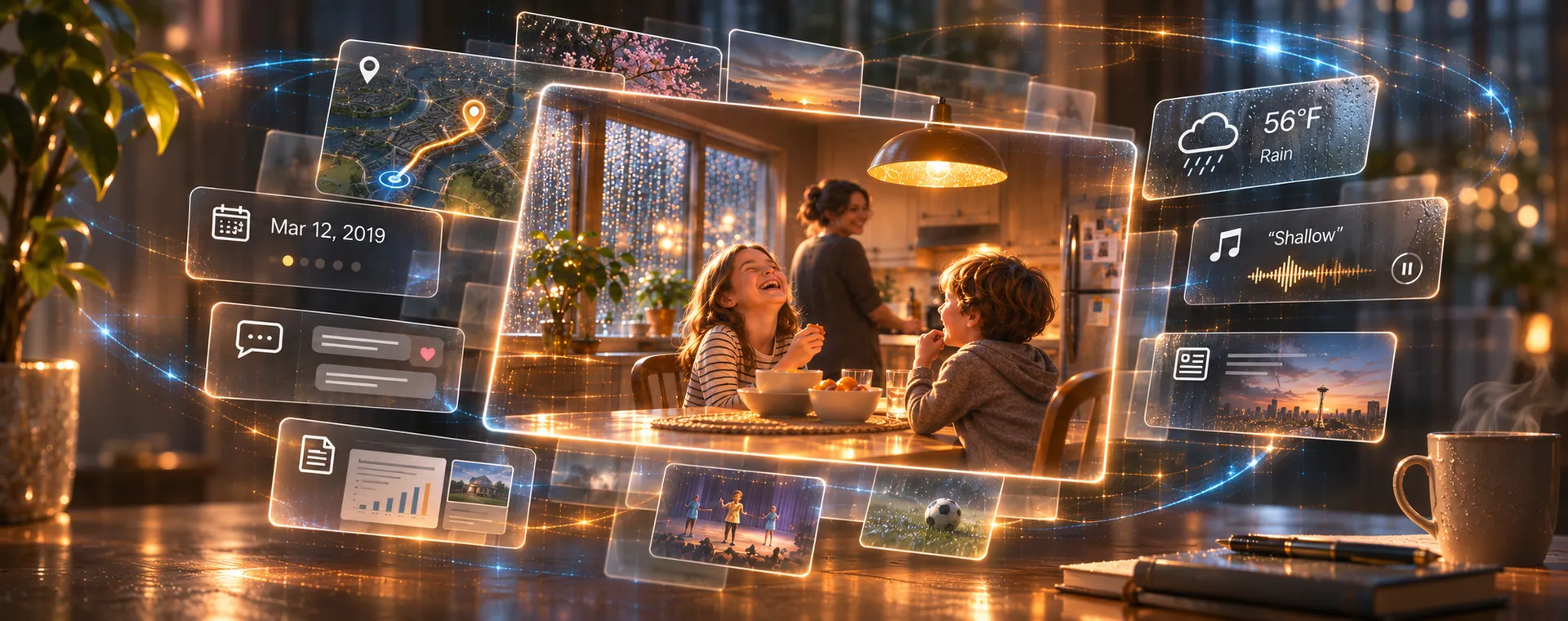
Now layer on public information that costs nothing to get. NOAA has the weather for that day. Billboard has the songs. The Wayback Machine has what the web looked like. The news is archived everywhere. None of that is personal, and all of it is what makes a reconstruction feel like a time instead of just a room.
The missing pieces stopped being missing
Five years ago the gap between having the data and rendering the day was enormous. It’s closing fast.
Video generation went from party trick to usable in about two years. Voice is further along than most people realize. Apple already ships Personal Voice, which builds a synthetic version of your voice from a short session of reading phrases out loud, entirely on device, as an accessibility feature. It’s free, and it’s on the phone in your pocket.
And the display problem got solved by hardware nobody bought for this purpose. Vision Pro and Quest 3 exist. They’re expensive and a little awkward and the install base is small. That’s the one piece of this that just needs a normal hardware curve and some time.
The models handle the gaps. Where the photos run out, inference takes over.
Three companies are positioned to build it
Anybody can rent a good model. The corpus is the hard part, and there are about three organizations holding enough of one.
Google has the widest reach: Photos, Maps Timeline, Gmail, Search, Android, plus the interest graph that makes an era feel like an era. Apple has the tightest combination, with the photo library, the on-device compute, the headset, and a privacy posture that makes people willing to say yes. Meta has the headsets people already own and the social graph that knows who was standing next to you.
A startup can’t do this, however much it raises. It would have to ask you to upload your entire life to a company you’ve never heard of, and nobody’s doing that.
The first version won’t be a headset
I’d bet against a big dramatic launch. Version one shows up as a tab in an app you already have.
The path probably looks like this: Today’s auto-generated memory recaps get noticeably better and start pulling in weather and music. Then you get a single room you can look around inside, built from one well-photographed evening. Then a whole day, rough at the edges, with people rendered as approximations. Then it gets conversational.
The first few passes will be clunky and slightly uncanny and people will dunk on them. That’s how this always goes, and it’s never once told us anything about where the thing ends up.
What it’s actually good for
Reminiscence therapy is established practice in dementia care already. Familiar music, objects, and photographs from someone’s past, used to reach them when ordinary conversation can’t. Right now it runs on shoeboxes and old records. Hand that field a reconstruction of the kitchen someone raised four kids in and they’d take it in a heartbeat.
There’s a plainer version I’d use myself. My daughter will never know what our house sounded like on an ordinary Tuesday when she was small. I barely know what my parents’ twenties looked like. Being able to show someone a day instead of describing it is a real thing to be able to do.
And a lot of it is just nostalgia, which is reason enough. Right now nostalgia mostly happens to you: a song comes on in the grocery store, or you find a photo while looking for something else, and you’re gone for a minute. This turns it into something you can choose to go do. Walk back into your college apartment. Sit in the passenger seat of the first car you owned. Stand in a room you’d forgotten you loved.
The part worth staying awake for
I’m excited about this, and I still think we should go in with our eyes open.
We built the conditions for this without deciding to. Every piece I listed above got collected for some other reason: a photo backup, a better map, a more relevant ad. Individually, all of it is boring. Assembled, it’s a searchable index of your entire adult life, and the same aggregation that makes a beautiful memory possible makes other things possible too.
Two specifics I’d keep an eye on. First, a reconstructed day is part record and part guess, and there’s no reason to assume it’ll be labeled. Researchers have shown for decades that doctored photographs can implant memories people then sincerely believe. Run a convincing simulation of a day enough times and it can become the version you remember.
Second, whoever can render your past that persuasively has a very good model of what moves you. That capability points at influence and persuasion as easily as it points at nostalgia, and it won’t announce which one it’s doing.
Other people are in these reconstructions too, and that’s where I’d draw the firmest line. Rebuilding a room from your own photos is one thing. Putting words in someone else’s mouth is another. If a reconstruction has another person speaking or sharing a thought, it should trace back to something they actually said, on record, and they should have agreed to be in it. Without that, the model is writing fan fiction with their face on it, and that can spin sideways fast.
I don’t have the exact rules worked out, and I’m not sure anyone does yet. But I’d want this built for entertainment first: something you watch and walk around in, clearly labeled as a reconstruction, never treated as a record of what happened. Consent built in from the start, kept on device where possible, and easy to delete for real. Get that part right and it’s a great night in with your family’s old house. Get it wrong and we’ve written the third act ourselves.
What I actually think
This idea doesn’t need an invention. Photo libraries, location history, ambient audio, cheap 3D reconstruction, voice synthesis, video generation, and headsets all matured on separate timelines for separate reasons, and they’re arriving at the same place at roughly the same moment. That’s usually what it looks like right before something new shows up.
I think one of the big three ships something recognizable within two to three years. I think it gets marketed as a warm little memory feature and lands in the photos app next to the birthday collages. And I think the first time somebody stands in their old kitchen and hears it rain, it’s going to land a lot harder than the demo suggested.
Take me back to March 12, 2019. Somebody’s going to say yes.